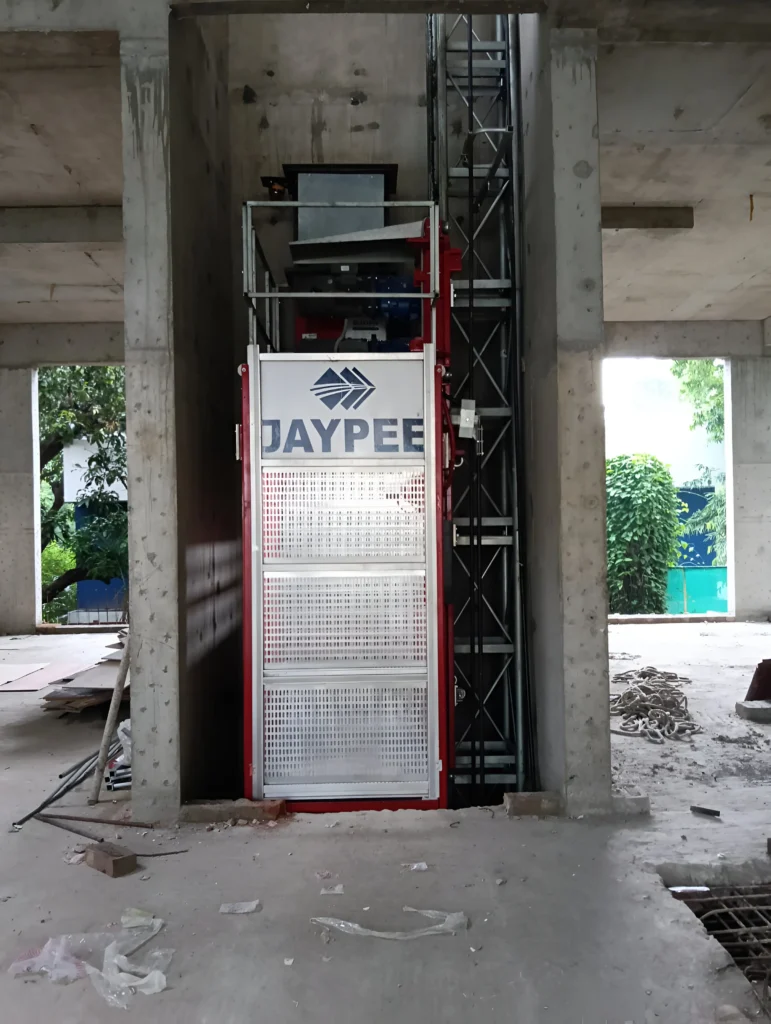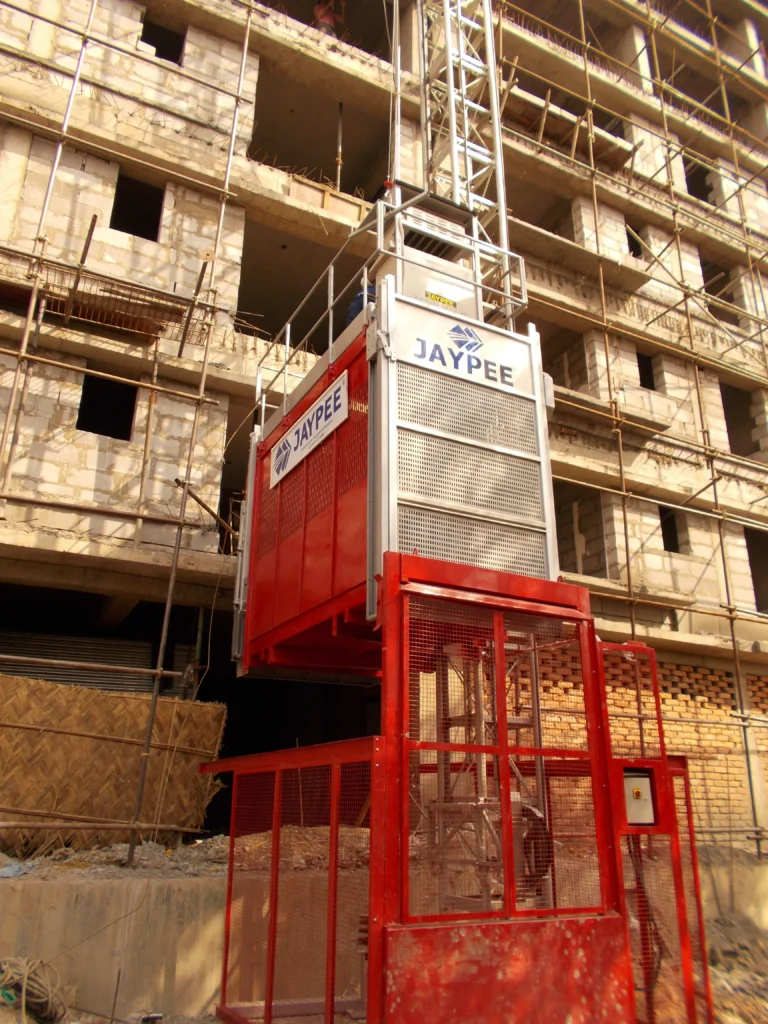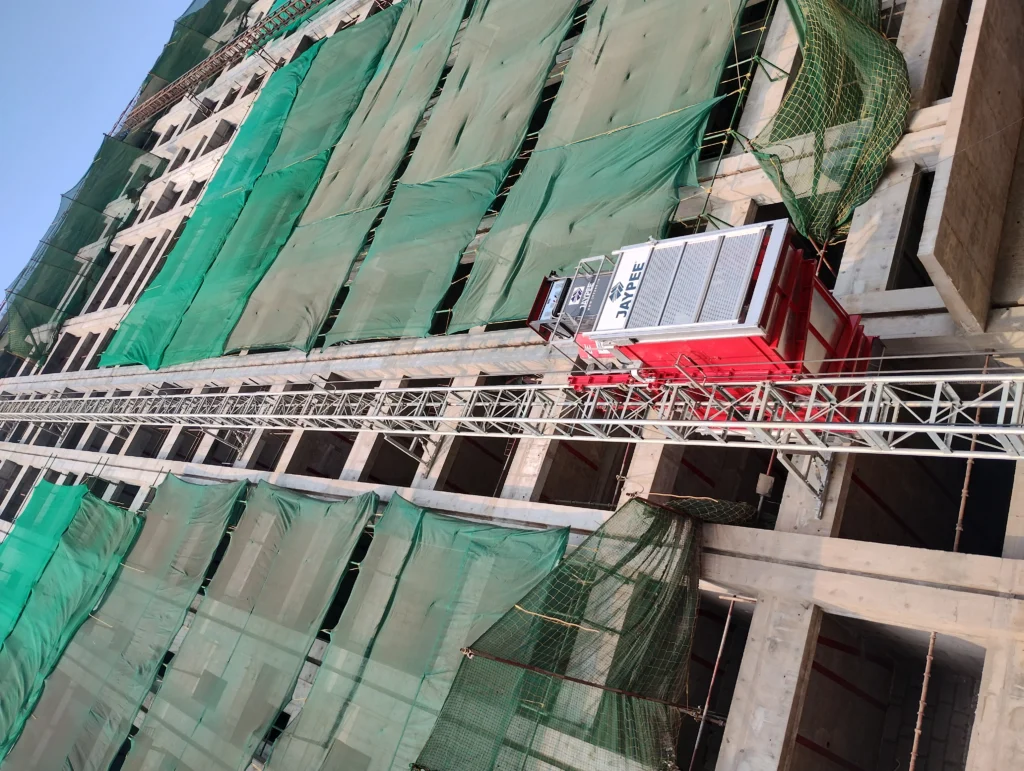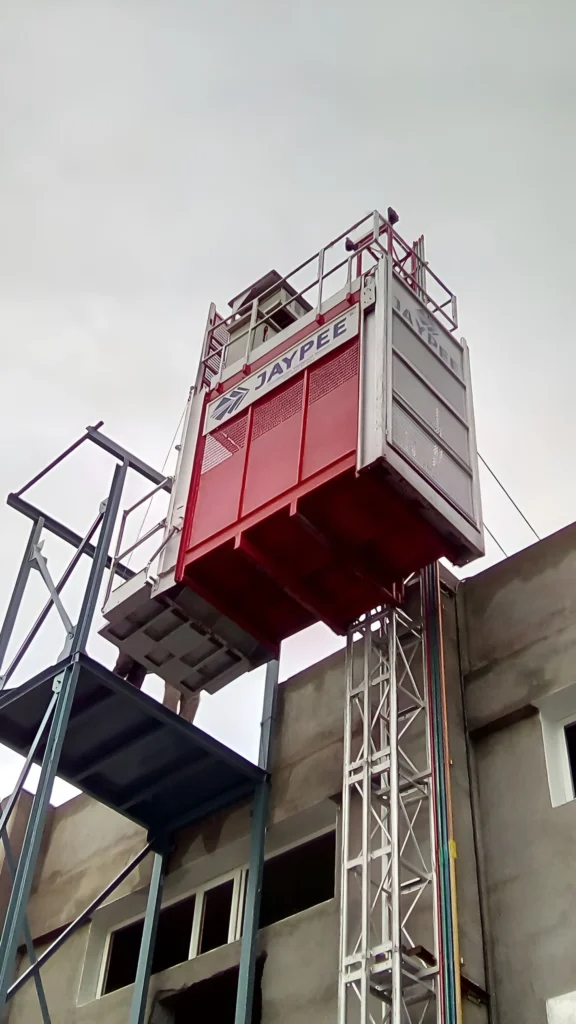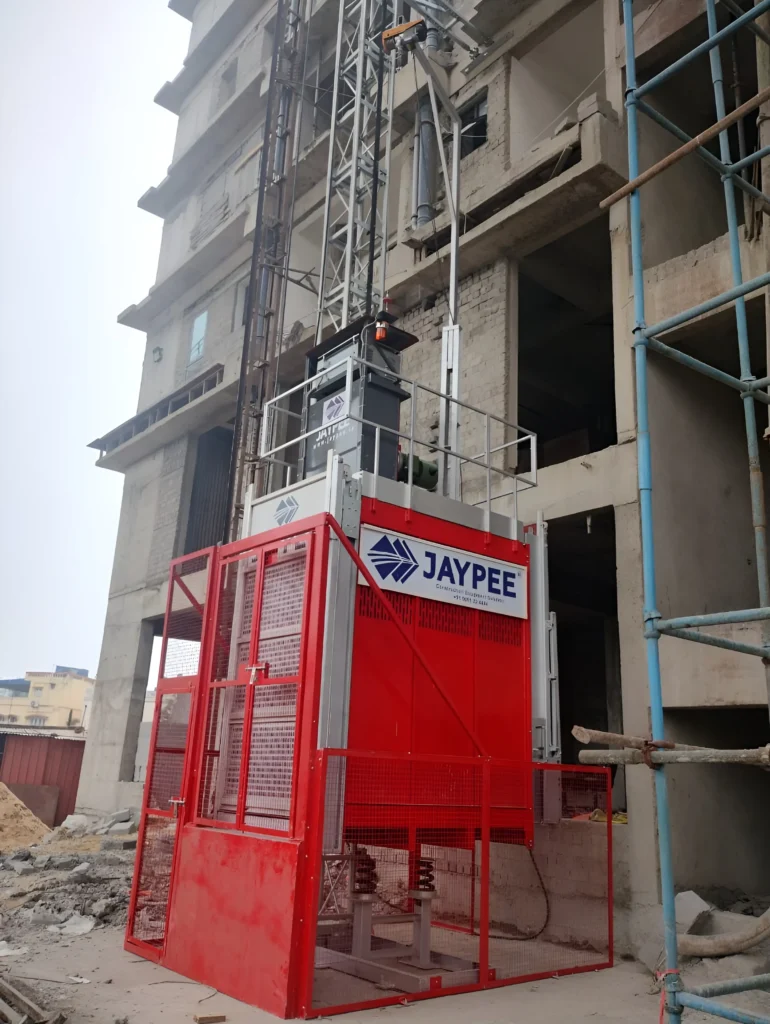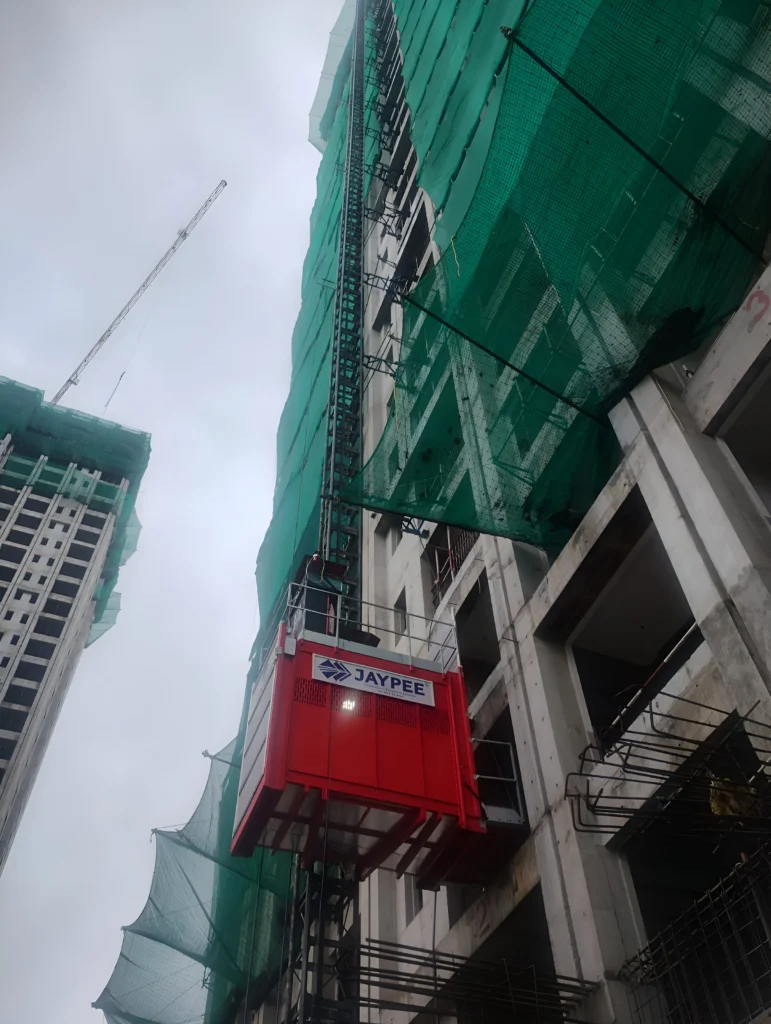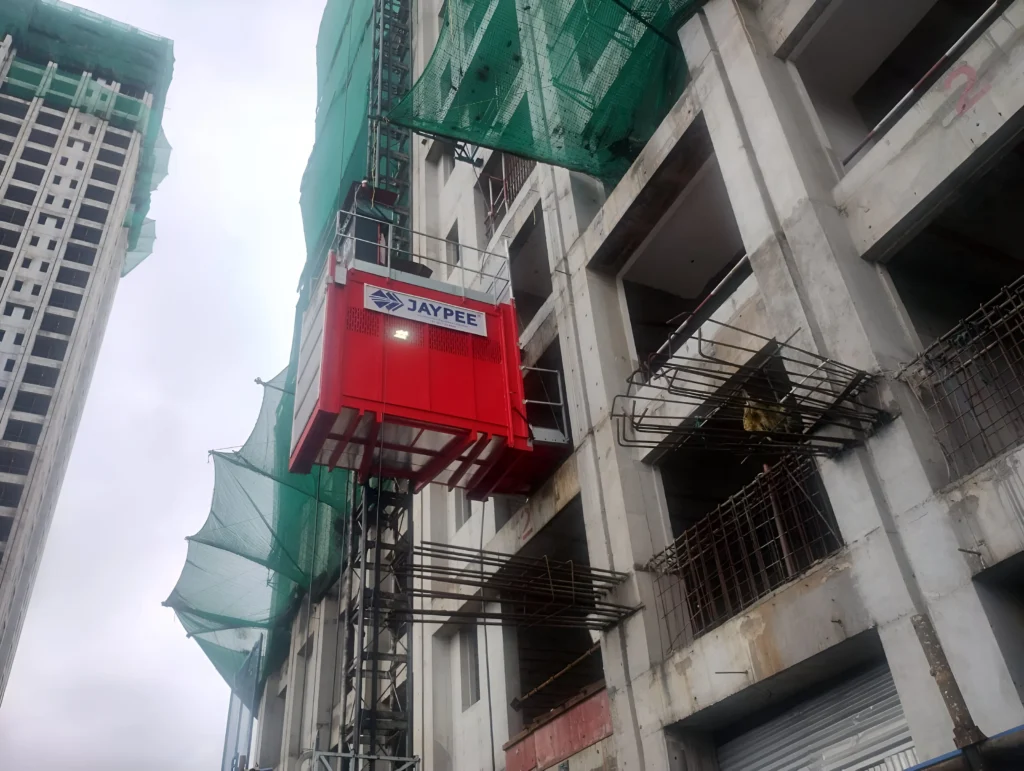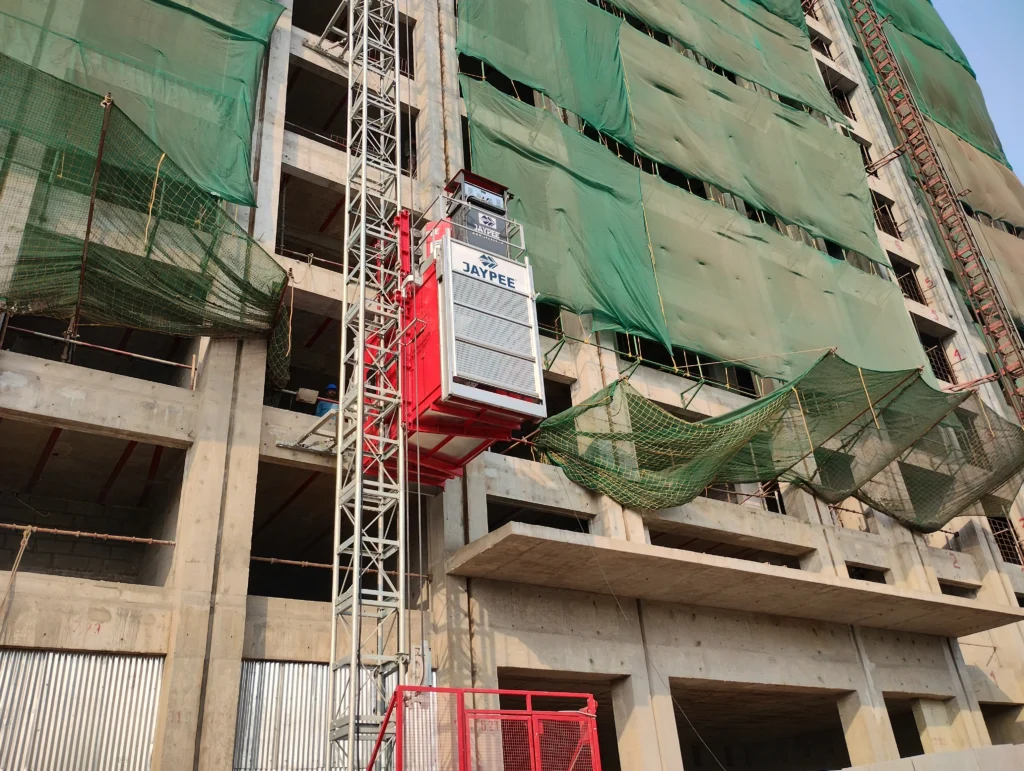
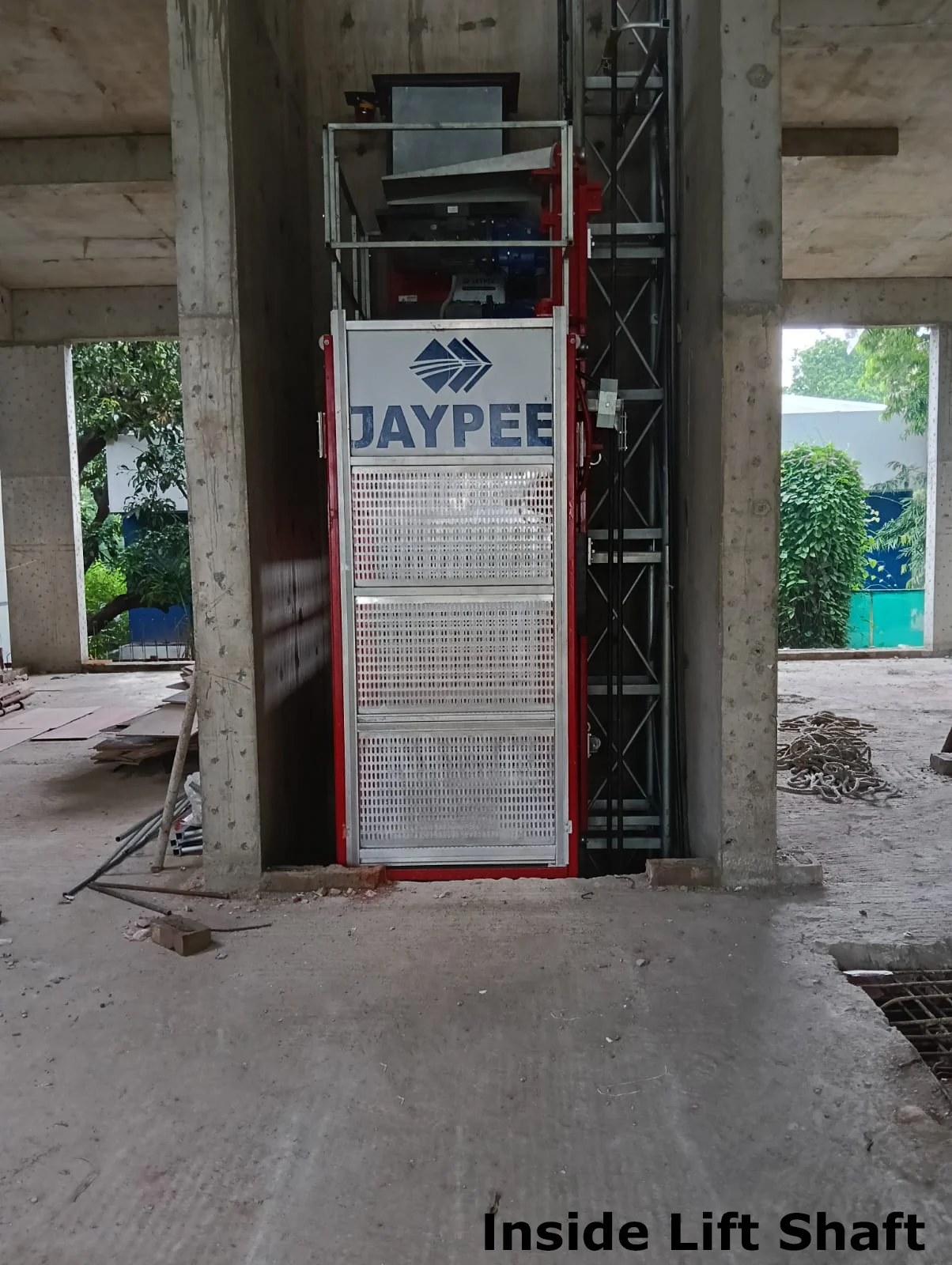


Typical applications and industries
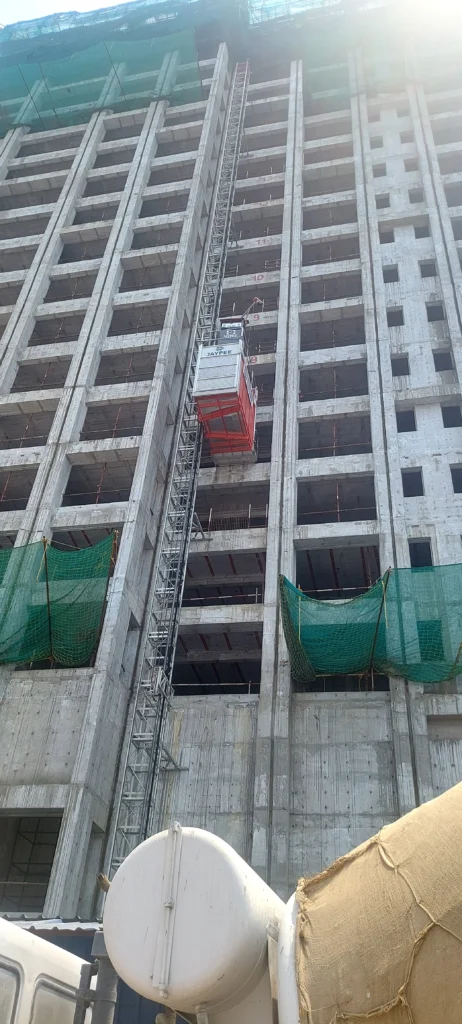
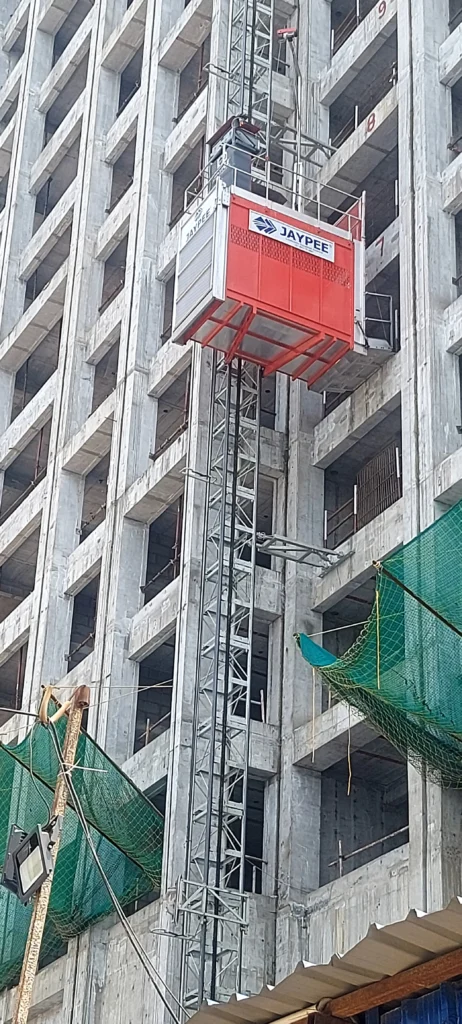
- Rack & pinion passenger hoists are used widely across:
- Building construction (residential, commercial, high-rise)
- Civil engineering works (bridges, tunnels — temporary access)
- Industrial plant construction and maintenance
- Retrofit and renovation projects
- Events and temporary structures where safe vertical access is required
Key technical specifications.
Note: The following specifications describe common configurations and options. Jaypee® offers customizable models to suit project-specific needs.
Capacity (passengers): 6–12 persons (or equivalent payload in kg — typically 450 kg to 1000 kg).
- Travel speed: Typical ranges 0.3 m/s – 1.0 m/s depending on model and site requirements.
- Lifting mechanism: Electric motor driving pinion gear engaging vertical toothed rack.
- Drive motor power: Sized per capacity and speed — common ranges 5 kW to 30+ kW for passenger hoists, with S1 duty ratings for continuous operation.
- Power supply: 415 V / 3-phase / 50 Hz (or site-specific supply). Provision for soft-start, VFD, or direct-online as required.
- Cabin/gondola dimensions: Configurable; typical internal floor area supports 6–12 persons.
- Mast/guide type: Modular bolted mast sections suitable for high-rise assembly; anti-tilt bracing options available.
- Stops and landings: Multi-stop full-floor landing capability with automatic leveling and landing safety devices.
- Controls: PLC-based control panel, push-button call/landing stations, emergency stop, overload detection.
- Safety brakes: Fail-safe mechanical brake, electromagnetic parking brake, and emergency mechanical locks.
- Ingress protection: Sealed electrical enclosures, weather protection for outdoor operation.
- Optional features: VFD for smooth speed control, remote diagnostics, CCTV in cabin, intercom or two-way communication.
Top safety features.
Safety is the single most important design driver for passenger hoists. Jaypee® hoists incorporate multiple layers of protection to ensure personnel safety during normal operation, emergency conditions, and rare failure modes. Below are the top safety features explained in detail.
1. Redundant mechanical holding systems
- Primary brake: Heavy-duty fail-safe brake on the drive system holds the drive shaft when power is removed.
- Secondary mechanical lock: A mechanical ratchet or pawl engages the rack in the event of uncontrolled motion, preventing free fall.
- Emergency friction brake / anti‑rollback device: Prevents the cage from moving unexpectedly during start/stop sequences.
- Why it matters: Mechanical redundancy ensures that even if a single braking component fails, one or more mechanical systems will prevent uncontrolled cage movement.
2. Overload detection and protection
- Load sensors / weight cell system: Prevents the hoist from operating if the cage is overloaded beyond rated capacity.
- Automatic lockout: Overload condition triggers an automatic lockout and alarm; lifting is inhibited until the load is reduced and reset.
- Why it matters: Overloading a hoist risks motor burnout and structural overload — automatic prevention reduces human-error related incidents.
3. Overspeed detection and governor systems
- Speed sensors and electronic governor: Continuously monitor travel speed; if speed exceeds preset limit, the governor triggers an emergency stop and mechanical locking.
- Mechanical overspeed governor: A centrifugal or mechanical governor provides an independent mechanical trip if electronics fail.
- Why it matters: Prevents uncontrolled or excessive speeds that could cause collisions, impact injuries, or damage the mast.
4. Emergency stop and rescue systems
- Emergency stop buttons: Located inside the cabin, at each landing call station, and on the main control panel — immediately cut power and initiate safe stop.
- Manual lowering / rescue winch: Allows trained personnel to lower occupants safely to the nearest landing in case of power failure.
- Dedicated rescue procedure: Clear documentation and site-specific training for performing a safe evacuation are provided.
- Why it matters: Power loss or control failure must not strand occupants without a safe rescue path.
5. Door interlocks and landing protection
- Positive locking door interlocks: Ensure the hoist cannot move unless all cabin doors and landing gates are fully closed and locked.
- Edge sensors and infrared curtains: Prevent doors from closing on passengers; modern systems use sensor arrays to detect obstructions.
- Landing gate protection: Landing gates on each floor are interlocked and cannot be opened unless the cage is present and secured.
- Why it matters: Prevents entrapment, inadvertent movement, and injury at landings.
6. Anti-tilt and lateral stability measures
- Guide rails and lateral rollers: Ensure the cage remains laterally constrained along mast, preventing tilt or sway.
- Anti-tilt sensors / mechanical stops: Detect or physically limit any rotation of the cage relative to mast.
- Why it matters: Safety during high winds, eccentric loading, or dynamic disturbances.
7. Emergency lighting & communication
- Battery-backed emergency lighting: Keeps the cabin and landings illuminated during power outages, aiding calm and safe evacuation.
- Two-way communication / intercom: Direct communication between cabin occupants and the site control desk or service team.
- Why it matters: Reduces panic and enables coordination during emergencies.
8. Fire and smoke protection
- Non-combustible cabin materials: Interior panels and structural materials chosen to minimize fire load.
- Smoke detection & alarm: Optional smoke detectors in the cabin trigger alarm and safe shutdown procedures.
- Firefighting plan integration: Hoist is positioned and managed so as not to hamper emergency egress or firefighting operations.
- Why it matters: In case of fire, the hoist must not become a hazard; instead, it must be able to support safe evacuation or remain inert as instructed.
9. Structural design safety and margin
- Engineered factor of safety: Structural members (mast, cabin frame, brackets) are designed with ample safety margins to handle dynamic loads, wind, and impact.
- Fatigue analysis & robust welding: Components subject to cyclic loads are designed and manufactured to reduce crack initiation and growth.
- Why it matters: Structural failure is catastrophic — design conservatism protects life and investment.
10. Electrical safety & earth-fault protection
- Ground-fault protection: Prevents electrical shocks and triggers safe shutdown in event of leakage currents.
- Phase-loss and under-voltage detection: Trips the drive if mains supply is compromised in a way that could damage equipment or create unsafe motion.
- IP-rated enclosures: Electrical panels rated for dust and rain exposure reduce failures from environmental ingress.
- Why it matters: Electrical faults are a major source of failures on construction sites — robust protection reduces their incidence.
11. Regular inspection & predictive maintenance features
- Condition monitoring: Modern hoists may include vibration sensing, motor current analysis, and runtime logs to detect wear early.
- Scheduled inspection points: Clear daily / weekly / monthly / annual checklists facilitate proactive safety checks.
- Digital logs: Maintenance actions, test results, and incidents recorded in a secure log for compliance and traceability.
- Why it matters: Many accidents are preventable with routine inspection — built-in monitoring helps catch issues early.
12. Personnel safety features
- Clear signage and load ratings: Ensure users understand safe operation limits and behavior inside the hoist.
- Controlled acceleration/deceleration: Smooth starts/stops reduce risk of fall or strain inside the cabin.
- Why it matters: Small ergonomic and human-factors measures reduce common injury modes.
Installation best practices
A safe and efficient installation is critical to long-term performance and safety. Below are proven best practices for installing a rack & pinion passenger hoist on construction sites.
1. Pre-installation survey
- Site leveling and foundation checks: Ensure the base foundation is adequate for mast loads and dynamic forces.
- Electrical supply verification: Confirm stable power source and necessary protection devices.
- Crane/handling plan: Coordinate lifting of mast sections and cabin components safely.
- Access & exclusion zones: Define safe work areas and emergency egress routes.
2. Erecting mast and bracing
- Use manufacturer-specified torque settings and bolt grades for mast section joints.
- Install temporary bracing at recommended intervals until permanent building ties are available.
- Check vertical plumb for the mast; rectify misalignments before finalizing anchor points.
3. Mechanical & drive assembly
Align the pinion and rack carefully to avoid wear and noise; maintain manufacturer-recommended backlash and lubrication.
Verify brake settings, parking brake engagement, and mechanical lock operation before testing under load.
4. Electrical wiring and control integration
- Install earth leakage and phase-loss protection at the point of supply.
- Ground the mast and cabin structure per local electrical code.
- Test all sensors, limit switches, interlocks, and emergency stop circuits before putting hoist into service.
5. Load testing and commissioning
- Conduct no-load, partial-load, and full-load tests across the entire travel range.
- Simulate emergency stop scenarios and validate rescue lowering procedures.
- Provide commissioning certificate and handover documentation to the site safety officer.
Operation and user training
Even the safest equipment can be misused. Structured training programs and clear operating procedures are essential.
1. Operator qualification
- Only trained personnel should operate the hoist control panel and perform routine checks.
- Training should include: pre-start checks, loading rules, behavior inside the cage, emergency procedures, and reporting protocols.
2. Daily checks.
- Visual inspection of mast, brackets, and cables.
- Check for unusual noise or vibration during a short travel cycle.
- Verify braking action, door interlocks, and landing alignment.
- Confirm communication equipment and emergency lighting function.
3. Safe riding practices
- No overcrowding; observe posted capacity limits.
- Keep limbs and objects inside the cabin; do not lean on doors.
- Avoid riding with loose materials on top of persons; secure cargo separately if allowed by the hoist’s rating.
4. Emergency response plan
- Site-specific rescue team and contact numbers displayed in the cabin.
- Regular drills for power loss and entrapment scenarios.
Maintenance schedule & troubleshooting guide
A robust maintenance regime extends life, ensures safety, and reduces downtime.
1 Typical maintenance intervals
- Daily / Pre-shift: Visual checks, interlocks, brakes, emergency systems.
- Weekly: Lubricate moving parts, check fasteners, inspect rack/pinion engagement.
- Monthly: Electrical checks, motor inspection, calibrate sensors.
- Quarterly / Semiannual: Brake performance test, backup power checks, structural inspection.
- Annual: Full teardown inspection, mast anchor check, certification testing.
2 Common issues & quick fixes
- Unusual noise during travel: Check rack/pinion alignment and lubrication; tighten loose fasteners.
- Door interlock failure: Inspect door switches, clean contacts, verify mechanical latches.
- Overload alarm triggers unexpectedly: Verify load cell calibration and rule out stuck sensor wiring.
- Intermittent power trips: Check for earth leakage, loose connections, or overheating.
3 When to call for professional service
- Brake slipping or inability to hold the vehicle securely.
- Structural damage to mast sections or cabin frame.
- Repeated electrical faults after basic checks.
Compliance, testing, and certification.
A passenger hoist should comply with applicable national and international standards, and it is important for buyers and site safety managers to verify the product’s compliance documentation. The following checklist helps organize compliance activities:
- Manufacturer’s statement of conformity and technical file.
- Factory acceptance tests (FAT) and site acceptance tests (SAT) records.
- Periodic inspection certificates from qualified third-party inspectors.
- Maintenance and incident logs required by local site regulations.
- Training certificates for operators and maintenance staff.
Note: Jaypee® provides documentation and testing support during commissioning to assist with regulatory compliance and site handover.